

What is Hypertension (High Blood Pressure)?
Hypertension is simply high blood pressure, where your blood pressure is higher than normal. Our blood pressure changes over the course of a day depending on our daily activities. However, having elevated blood pressure can be a sign of something unpleasant: uncontrolled high blood pressure can lead to a higher risk of health problems such as heart attack or even stroke. In Malaysia, 3 out of 10 adults over the age of 18 are diagnosed with hypertension. This can be prevented if more Malaysians are aware of their optimal blood pressure reading.
Blood pressure is “the pressure of blood pushing against the walls of your arteries.” It is measured in millimetres of mercury (mmHg). The normal blood pressure level of a person is less than 120/80 mmHg.
This article will discuss blood pressure readings, how to measure them yourself and share useful information on the subject. You can learn more about hypertension from our article, and pick up some useful tips to lower your blood pressure from here.
A Brief on Blood Pressure Readings
If you are unfamiliar with the meaning behind your blood pressure reading, let this quick primer bring you up to speed.
Take the normal blood pressure reading, 120/80 mmHg. The first number is your systolic blood pressure, which measures pressure in your blood vessels every time your heartbeats. The second number represents your diastolic blood pressure, which is pressure in the arteries when the heart rests between beats.
The reason why mmHg is used in readings is that mercury was used in the first accurate pressure gauges that were created many, many years ago.
Blood Pressure Categories
As mentioned earlier, normal blood pressure is less than 120/80 mmHg. Any major changes to this amount can be a sign of hypertension or even hypotension, which is the opposite of hypertension (low blood pressure). It is important to have your blood pressure taken consistently. Some experts suggest having it checked every 3 to 6 months; if your blood pressure is higher than normal, have it checked every month, if possible.
Consider the following table adapted from the American Heart Association:
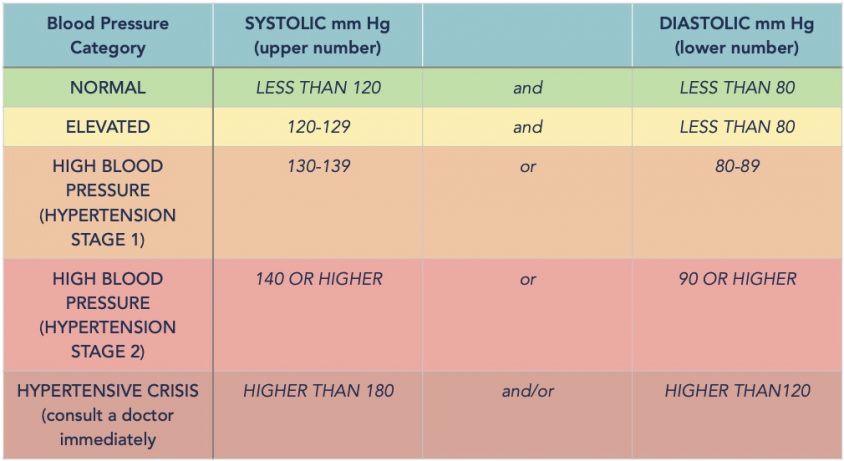
Elevated blood pressure is an intermediate stage that comes with a higher risk of developing hypertension. At this stage, you can make changes to your lifestyle or get a medical recommendation to control your blood pressure and greatly reduce the risk of developing hypertension.
Hypertension stage 1 is bringing you that much closer to hypertension. While it is called hypertension stage 1, the actual diagnosis of hypertension is based on the average blood pressure readings over a period of time. Hypertension stage 2 is when you have actual hypertension, with readings going over 140/90 mmHg. Because there is a much higher risk of heart-related diseases, your doctor may make recommendations to take blood pressure medication to keep your levels under control. This will go together with lifestyle changes to keep blood pressure at normal (or controllable) levels.
While hypertension is already a serious condition, if the reading goes even higher than 140/90 mmHg, this is called a hypertensive crisis. If you also find yourself (or your loved one) experiencing symptoms such as chest pain, shortness of breath, numbness, dizziness, or severe headaches, it becomes very important that you get medical help immediately.
Every individual is different, and your loved one has care needs that are unique. Engaging a caregiver for your loved one not only encourages interaction; it also helps build strong emotional support.
To give your loved one the best care he/she deserves, we provide a free care consultation to ensure that they get a Care Professional that best suits their needs.
Monitoring at Home
With advances in technology, you can now consider owning a medical device to measure blood pressure and have it done from the comforts of your own home. However, before you excitedly reach for your phone and search for one on Shopee or Lazada, you will need to consider a few important points.
- Get a clinically certified device that is easy to use
- Alternatively, get a doctor’s recommendation for an ideal device to own
- Consider the device’s features, such as the size, display and overall cost
- Purchase one from a pharmacy or medical store, as you can see the product in hand and get advice or suggestions from the staff
- Before using it, get a doctor to check the accuracy of its readings, and help out with other aspects that you might need to know about
It is recommended that you purchase an automated blood pressure monitor with a digital readout. An automated monitor eases the measurement process and ensures you get an accurate reading with minimal effort. The monitor will also come with an upper arm cuff that fits around your arm; you must make sure the cuff fits nicely around the arm, or you may get an inaccurate blood pressure reading.
You can also consider wrist monitors, but generally, cuff-based monitors are recommended for having better reading accuracy. Consult your doctor for their recommendation. Alternatively, you can head to validateBP.org for validated blood pressure monitors that meet the American Medical Association’s criteria.
Besides the convenience, regularly checking your blood pressure at home helps give your care professional a full picture of your daily blood pressure readings and how your overall lifestyle affects it. With the COVID-19 pandemic, it also helps to stay at home as much as possible, and stay connected with your doctor over the phone or via video call, or unless it is absolutely necessary to see them in person.
An additional reason to check your blood pressure at home is due to a phenomenon called the “white coat effect.” According to this effect, the stress of taking your blood pressure at a clinic or hospital can actually raise your blood pressure, which then leads to an inaccurate reading. You may have some anxiety when getting a medical check-up, and that will inadvertently lead to a brief increase in your blood pressure.
This effect can also manifest in other situations, especially in stressful times. You can find out more in our article about hypertension.
Monitoring at home also gives you control over your life. By seeing the direct results of your readings and the ways you are keeping your blood pressure under control, you will also feel a sense of pride and accomplishment for keeping your health in check. You may even feel more motivated to do more things to further improve your overall health.
Low Blood Pressure
Low blood pressure, or hypotension, is the opposite of hypertension: your blood pressure is lower than the normal range. Generally, this is defined as 90/60 mmHg. Much like hypertension, hypotension could be a sign of some underlying condition.
If you have hypotension, you may have any of the following symptoms:
- Dizziness
- Blurry vision
- Nausea, fatigue
- Unable to focus
- Fainting spells
There are several reasons low blood pressure can occur.
- Dehydration
- Underlying heart issues (i.e. irregular heart rate)
- A decrease in blood volume (i.e. from blood loss)
- Side effects of medication
- Pregnancy
- Significant emotional stress
Be sure to check your readings and take a repeat reading to make sure the accuracy is correct. On its own, a lower reading should not be a cause for alarm. However, if your readings are consistently below the range of 90/60 mmHg, and you also have any of the symptoms of hypotension, contact your doctor immediately for a check-up. If you are taking any medications known to cause a reduction in blood pressure, inform your doctor; ideally, you should disclose this information to them at an earlier stage.
Do’s and Don’ts of Monitoring
Here are some things to remember before, during and after taking your blood pressure.
- Avoid smoking, drinking, taking medications or vigorous physical activity 30 minutes before you take your blood pressure. All of these will increase your blood pressure and lead to inaccurate results.
- Make sure your bladder is empty before you start.
- Try to measure your blood pressure at consistent times throughout the day for consistent readings.
- Place the arm cuff on your bare arm; do not place it over the clothing.
- Sit upright with your back properly supported; keep your feet flat on the floor, and have your arm supported at heart level.
- Do not take the measurement immediately. Set a five-minute window to relax before you take the measurement.
- Avoid talking or moving around while taking the measurement. Breathe in and out slowly at regular intervals.
- Take a repeat reading after a one to the three-minute interval.
- Write down the readings in a journal; ensure you take down the time you took the readings as well.
- Bring your journal along when you see your doctor; also bring along your blood pressure monitor for regular accuracy checks to make sure it is accurately taking your blood pressure.
Managing Blood Pressure
You must make lifestyle changes to help with keeping your (or your loved one’s) blood pressure under control. Regular exercise, a healthy and well-balanced diet, quitting smoking, and reducing your alcohol intake can all contribute to maintaining blood pressure at normal levels, allowing you to live a healthy, worry-free life.
If you find it difficult to cope with managing you or your loved one’s blood pressure levels, or if you believe you could use some support to manage daily life activities, do consult your doctor for meaningful advice. A support group is also a good idea if you are seeking help and guidance from individuals with a similar condition, allowing you to build friendships and support one another. You can also contact our helpful Homage care advisors and care specialists at 016 299 2188 for personal care either for yourself or your loved one.
Are you looking for someone to care for you and your loved ones?
Homage provides caregiving services for your loved ones at every stage. Our trained care professionals are able to provide companionship, nursing care, night caregiving, home therapy and more, to keep your loved ones active and engaged.
Provide the best care to your loved one today! Fill up the form below for a free consultation with our Care Advisory team.
Ambardekar, N. (2020). Diastole vs. Systole: Know Your Blood Pressure Numbers. Retrieved 11 August 2021 from https://www.webmd.com/hypertension-high-blood-pressure/guide/diastolic-and-systolic-blood-pressure-know-your-numbers
American Heart Association. (n.d.). How to accurately measure blood pressure at home. Retrieved 11 August 2021 from https://www.heart.org/en/news/2020/05/22/how-to-accurately-measure-blood-pressure-at-home
American Heart Association. (n.d.). Understanding Blood Pressure Readings. Retrieved 11 August 2021 from https://www.heart.org/en/health-topics/high-blood-pressure/understanding-blood-pressure-readings
American Heart Association. (n.d.). Monitoring Your Blood Pressure at Home. Retrieved 11 August 2021 from https://www.heart.org/en/health-topics/high-blood-pressure/understanding-blood-pressure-readings/monitoring-your-blood-pressure-at-home#.WKY6PRIrLVo
Blood Pressure UK. (n.d.). Monitoring your blood pressure at home. Retrieved 11 August 2021 from http://www.bloodpressureuk.org/your-blood-pressure/how-to-lower-your-blood-pressure/monitoring-your-blood-pressure-at-home/
Busie, C. & Nall, R. (2018). Automated vs. Manual Blood Pressure Readings: Guide to Checking Blood Pressure at Home. Retrieved 11 August 2021 from https://www.healthline.com/health/how-to-check-blood-pressure-by-hand
Centers for Diseases Control and Prevention. (2021). High Blood Pressure Symptoms and Causes. Retrieved 11 August 2021 from https://www.cdc.gov/bloodpressure/about.htm
Cleveland Clinic. (2019). Low Blood Pressure (Hypotension). Retrieved 14 August 2021 from https://my.clevelandclinic.org/health/diseases/21156-low-blood-pressure-hypotension
Madell, R. (2020). Blood Pressure Readings Explained. Retrieved 11 August 2021 from https://www.healthline.com/health/high-blood-pressure-hypertension/blood-pressure-reading-explained
Mayo Clinic. (2020). Get the most out of home blood pressure monitoring. Retrieved 11 August 2021 from https://www.mayoclinic.org/diseases-conditions/high-blood-pressure/in-depth/high-blood-pressure/art-20047889
Mayo Clinic. (2021). High blood pressure (Hypertension). Retrieved 11 August 2021 from https://www.mayoclinic.org/diseases-conditions/high-blood-pressure/symptoms-causes/syc-20373410
Mayo Clinic. (2020). Low blood pressure (Hypotension). Retrieved 14 August 2021 from https://www.mayoclinic.org/diseases-conditions/low-blood-pressure/symptoms-causes/syc-20355465
National Health Service. (2020). Low blood pressure (hypotension). Retrieved 14 August 2021 from https://www.nhs.uk/conditions/low-blood-pressure-hypotension/
World Health Organization. (2021). Hypertension. Retrieved 11 August 2021 from https://www.who.int/news-room/fact-sheets/detail/hypertension